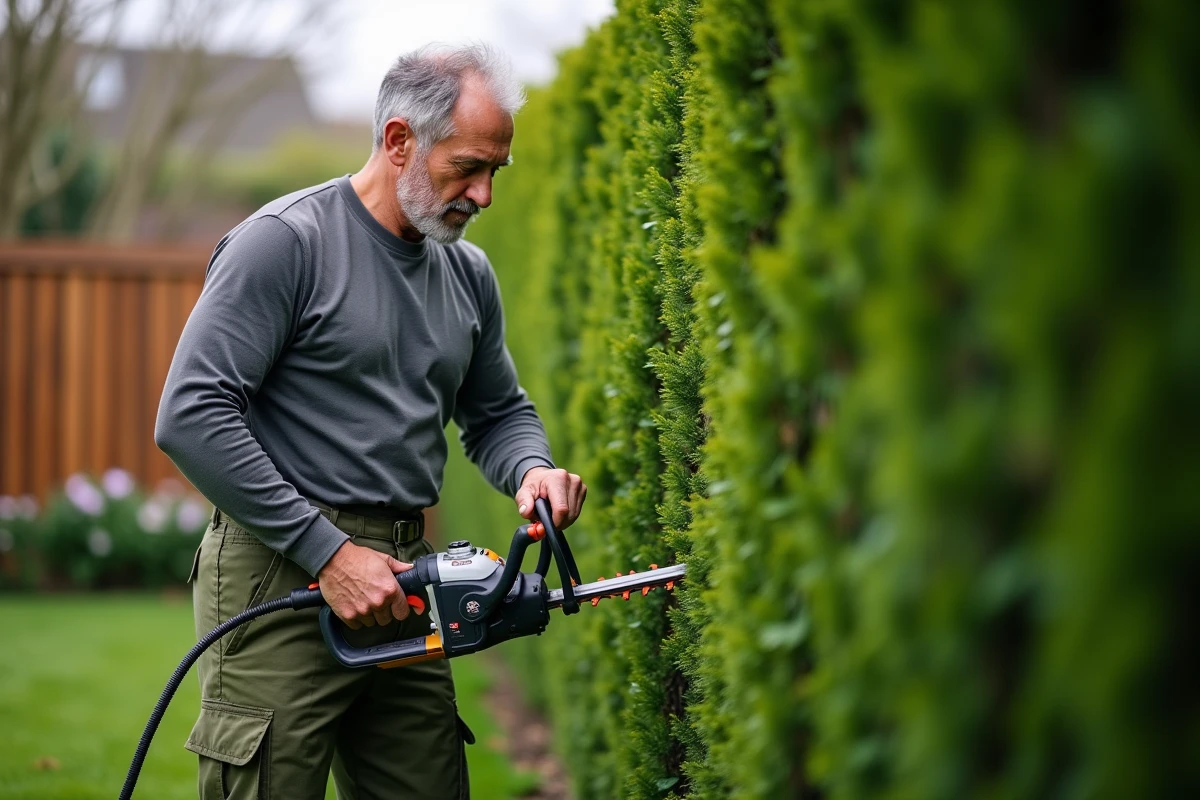
The choice of a hedge trimmer relies less on raw power than on the suitability between the blade, the type of vegetation, and the frequency of intervention. We regularly observe oversized purchases (gas-powered for a less than one-meter privet hedge) or undersized ones (low-end corded for old cherry laurel). This article targets the technical criteria that truly make a difference in use.
Tooth spacing and cutting geometry: the criterion that product sheets hide
The spacing of the blade’s teeth determines the maximum branch diameter that the hedge trimmer can cleanly cut. A tight spacing is suitable for boxwood or hornbeam hedges, trimmed several times a season, where the shoots rarely exceed one centimeter. A wide spacing, often associated with double-action blades, accommodates thicker branches, typical of photinia or laurel palm left unattended for a few months.
An inappropriate spacing causes branches to be crushed instead of cut. The result: plant injuries that turn brown, promote fungi, and degrade the appearance of the hedge in just a few weeks. We recommend systematically checking this data before considering engine power.
The blade geometry also plays an underestimated role. Single-action blades (with one set of mobile teeth) vibrate more and tire the arms faster. Double-action blades (where both sets of teeth move alternately) reduce vibrations and provide a cleaner cut.
On a trimming job lasting over an hour, the difference in comfort is considerable. Several ranges available on taille-haie-warrior.com allow for comparing these blade configurations according to the hedge profile.

Shared battery or dedicated tool: weighing the real cost of a cordless hedge trimmer
The main manufacturers (Bosch, Makita, Stihl, Husqvarna, Ryobi) are developing ranges with a single battery powering hedge trimmers, lawn mowers, brush cutters, and blowers. This multi-platform system radically changes the economic calculation.
The cost of the battery often represents a third of the total price of the tool. A gardener already equipped within a brand ecosystem can purchase the tool bare (without battery or charger), significantly reducing the bill. On the other hand, committing to an ecosystem solely for a hedge trimmer only makes sense if other purchases are planned in the short term.
Sales of battery-powered garden tools are significantly increasing compared to gas-powered ones in the residential segment, a trend that has intensified in 2023-2024. This shift is not only motivated by comfort: municipal regulations limiting the use of noisy tools to certain time slots have been multiplying since 2023, especially in dense areas.
Real autonomy and battery voltage
The voltage (expressed in volts) gives an indication of the motor torque. 18 V models are sufficient for regularly trimmed low hedges. High or old hedges, with more resilient branches, require 36 V or 40 V to maintain cutting speed without straining.
The autonomy announced by the manufacturer rarely corresponds to intensive use on dense vegetation. Having a second charged battery remains the most reliable solution for long hedges.
Noise level of the hedge trimmer: a criterion that has become regulatory
Noise is no longer just a matter of comfort. Several municipalities have strengthened their regulations regarding noise pollution, limiting the use of gas-powered hedge trimmers to specific time slots (often during the week, outside of lunchtime). An electric or battery-powered hedge trimmer reduces the risk of violation and neighborhood conflict.
Gas models generally operate well above the thresholds considered bothersome in residential areas. Battery models have a significantly lower noise level, allowing for more flexible use during the day.
- Check your municipality’s regulations before purchasing a gas model: some authorized time slots are reduced to just a few hours per day.
- Prefer a battery model if the hedge runs along a property line in a dense residential area.
- Consult the noise level in decibels on the technical sheet, not on the marketing packaging, which sometimes mentions acoustic power (higher than the sound pressure measured at the ear).
Pole hedge trimmer: when is it really justified?
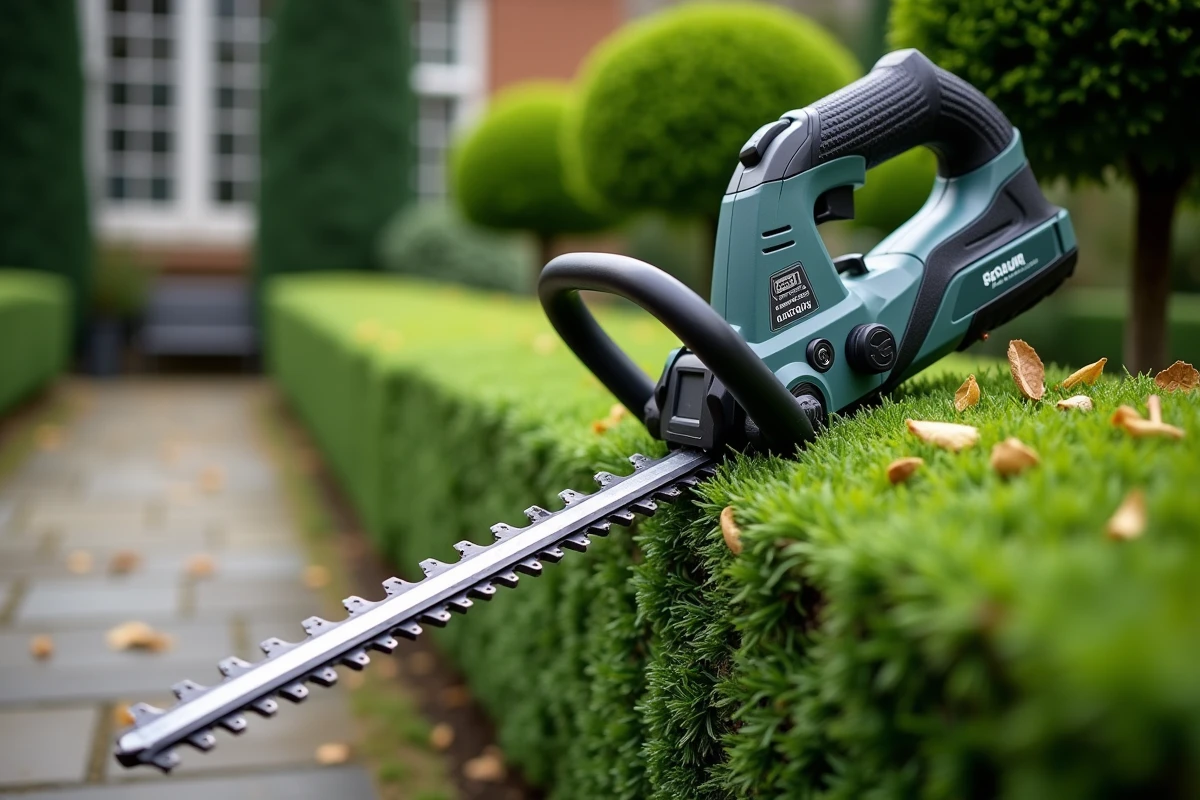
A pole hedge trimmer does not replace a standard model, it complements it. Its use is justified for hedges exceeding two meters in height or for wide upper faces inaccessible from the ground. Outside of these situations, the extra weight and leverage make the tool more tiring and less precise than a standard model.
Telescopic poles add between one and two kilograms to the total weight. With arms extended above the head, this extra load limits comfortable working time to just a few dozen minutes. For a tall but short hedge, a stable step ladder combined with a standard hedge trimmer often provides better cutting control.
Blade maintenance after each session
Regardless of the chosen model, the blade must be cleaned and lubricated after each use. Resinous sap (thuja, cypress) sticks to the teeth and accelerates wear through friction. A simple wipe followed by a spray of lubricant significantly extends the lifespan of the blade. A clogged blade forces the motor and reduces battery autonomy.
Sharpening can be done with a flat file for wide-toothed blades, but fine-toothed blades require a visit to a professional sharpener or the replacement of the blade set. Checking the availability and price of replacement blades before purchase avoids unpleasant surprises two years later.
The most suitable hedge trimmer is not the most powerful or the most expensive. It is the one whose tooth spacing matches your vegetation, whose battery integrates into an existing tool park, and whose noise level respects local constraints. These three parameters, rarely highlighted in consumer comparisons, nevertheless determine actual satisfaction in use.