The name Ambre is now one of the most popular choices in French maternity wards. According to the INSEE name database (2026 edition), 2,805 girls were given this name in 2025, placing Ambre third among girls’ names, up 24% over five years.
Behind this trajectory lies a word with a more complex linguistic history than it might seem: Arabic ʿanbar, fossilized resin, sperm whale secretion and a perfumery accord all coexist under the same label.
Ambre in numbers: births, ranking and trends over twenty years
Ambre does not follow the classic pattern of a fashionable name that suddenly takes off and then fades away. Its rise has unfolded over several decades, setting it apart from names with a single peak, such as Enzo or Manon.
| Period | Trend observed | Position in the rankings |
|---|---|---|
| 1970s–1990s | Rare appearances; an uncommon name | Outside the top 100 |
| 2000s | Steady growth | Entered the top 50 |
| 2010s | Marked acceleration | Top 10 |
| 2025 | Up 24% over 5 years | Ranked third among girls’ names |
Its lasting place near the top of the rankings is partly explained by a slow-wave effect: parents who grew up hearing the name in the 2000s find it familiar without feeling it has become overused. This virtuous circle helps sustain its popularity.
To explore the meaning of the name Ambre in more depth, we need to trace its linguistic roots, which reveal a word far more ambiguous than a simple reference to a golden stone.
Ambre name etymology: three substances behind a single word
Name guides generally attribute a single Arabic origin to Ambre. The word’s history is more layered.
Ambergris, the word’s starting point
The Arabic term ʿanbar originally referred to ambergris, a secretion from the sperm whale’s intestines. This substance, expelled into the sea and later washed ashore, was used for centuries as a fixative in perfumery. Its rarity and high price made it a luxury commodity in medieval trade between the Arab world and Europe.
Yellow amber, a shift in meaning
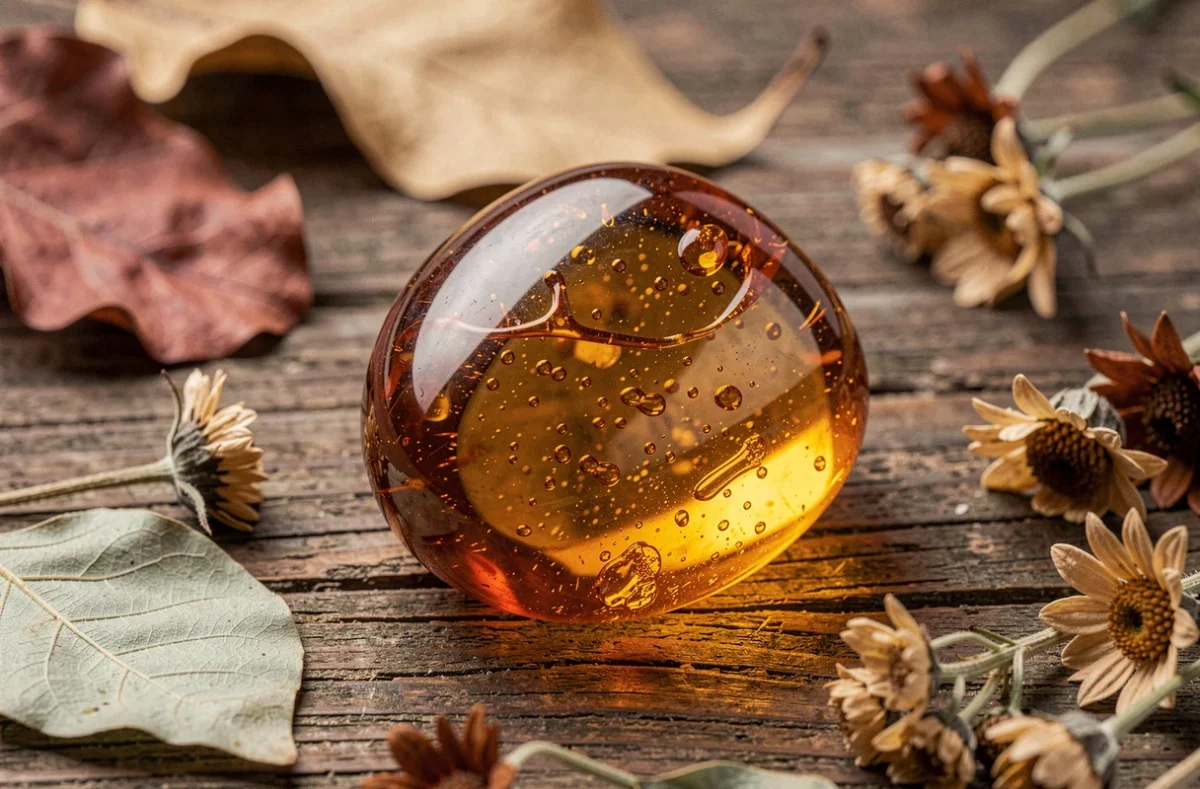
As the word entered European languages, “amber” also came to refer to yellow fossilized resin, plant matter trapped in sediment for millions of years. Used in jewelry since prehistoric times, this resin has no chemical or biological connection to ambergris. French brought two radically different substances together under a single term.
The amber accord in modern perfumery
The confusion does not end there. In contemporary perfumery, an “amber note” almost never contains genuine ambergris. It refers to a warm olfactory accord, often made with vanilla, benzoin and labdanum, sometimes combined with synthetic substitutes. The word has therefore shifted for a third time, moving from a tangible animal-derived substance to an abstract category in the perfumer’s palette.
- Ambergris: a substance of animal origin (sperm whale), historically used as a perfume fixative and now largely replaced by synthetic molecules
- Yellow amber: fossilized resin of plant origin, used in jewelry and decoration, with no connection to perfumery
- Amber accord: a modern olfactory family, an aromatic blend based on vanilla, benzoin and labdanum that borrows the name, not the substance
This triple identity is no trivial matter when it comes to the name. It explains why Ambre evokes warmth, rarity and softness all at once—a sensory combination that no other material-inspired name (Jade, Opale, Agathe) conveys quite as broadly.
Why Ambre appeals to French parents: factors behind its popularity
Ambre’s rise is not down to a single media trigger. Several factors have converged.
Ambre belongs to the family of material-inspired names, a trend that has gained momentum in France since the 1990s. Jade led the way, followed by names such as Opale and Perle. These short, evocative names, which are easy to pronounce in several languages, meet a demand for simple, pleasing sounds.
The name also benefits from a dual cultural association. On the Greek side, its connection to ambrosios (“immortal”) and ambrosia, the nectar of the gods of Mount Olympus, adds a mythological dimension. On the Arabic side, its association with a precious, fragrant substance gives the name a sensory quality.
Its sound also plays a measurable role. Two syllables, an open vowel at the start and a soft “bre” ending: Ambre shares its phonetic structure with other rapidly growing names (Aure, Ombre).
Ambre also carries no strong social marker. Unlike some names whose geographic distribution is highly concentrated, Ambre has no strong regional association, which limits the risk of local saturation.

Ambre’s name day and place in the calendar
Ambre’s name day is celebrated on December 7, a date listed in the saints’ calendar (source: Nominis). It falls under the sign of Sagittarius, a detail often included in astrological name guides.
Its place in the calendar is a recent addition. Like most material-inspired names, Ambre is not associated with a known historical saint. This calendar association does not change its everyday use in family celebrations.
The name has a few variants: Ambra (Italian form), Amber (English form) and, less commonly, Ambrine. Diminutives are not widely established, suggesting that the short form of the name works perfectly well on its own.
Ambre’s trajectory shows how a word can travel through the centuries, changing its substance—quite literally—while retaining an aura of warmth and rarity. Perhaps it is this unconscious polysemy—golden resin, enveloping fragrance, mythological echo—that explains why the name withstands the ebb and flow of fashion while other material-inspired names plateau.