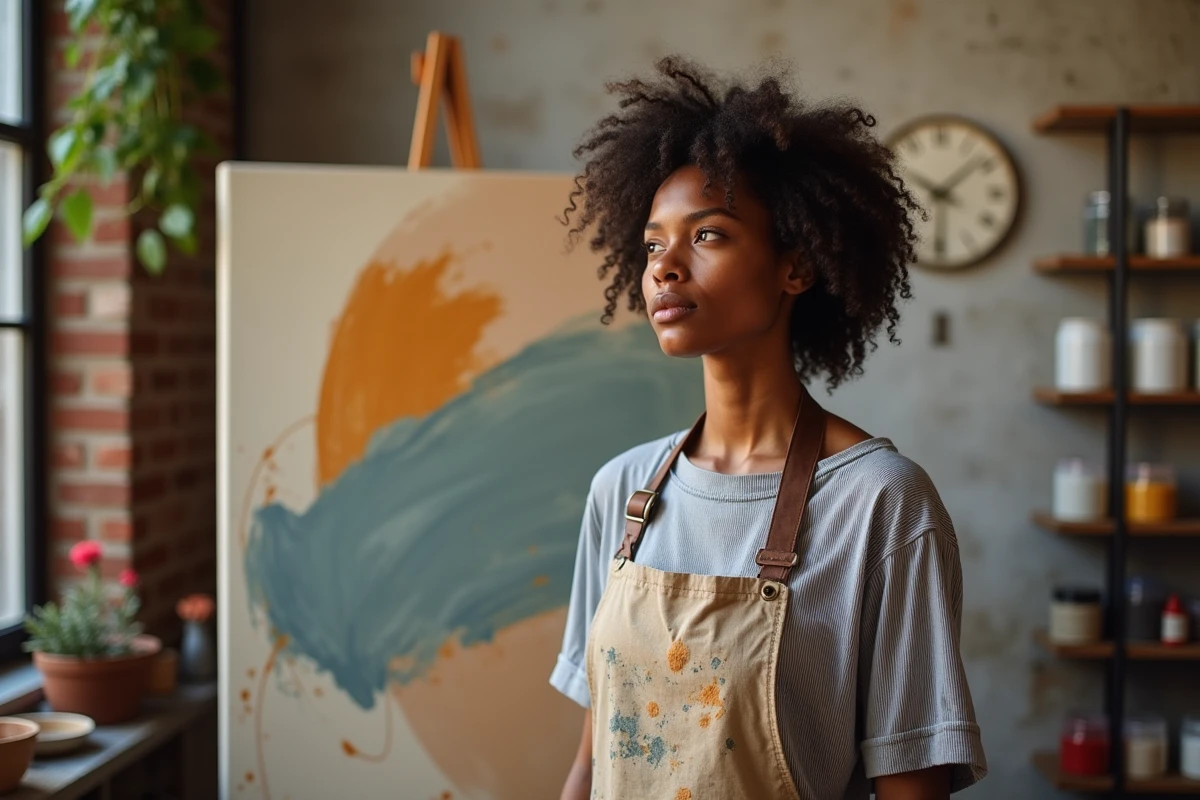
Creativity is not a personality trait reserved for artists. It is a documented cognitive process, observable through neuroimaging, that simultaneously engages several brain networks. Recent cultural policies have understood this: since the health crisis, culture and creation have been treated as levers for democratic resilience, not just as an economic sector to support.
Brain Networks and the Creative Process: What Neuroscience Changes
The creative brain does not operate in a single mode. Three main networks interact during a creative task: the default mode network (daydreaming, free associations), the executive control network (evaluation, sorting), and the salience network (switching between the two previous ones). Creativity relies on the coactivation of these three networks, which clearly distinguishes it from mere imagination or analytical problem-solving.
This understanding has concrete consequences. An artist who alternates between phases of free exploration and phases of critical judgment unknowingly reproduces the neural pattern identified by research. Forcing either phase at the wrong time (evaluating too early, daydreaming too long) degrades the quality of the creative process.
We observe that artistic training programs that integrate these concepts produce more consistent results than purely intuitive approaches. It is not a question of talent; it is a question of cognitive sequencing.
Resources like ouvre-tete.fr allow for the exploration of these intersections between culture, creative intelligence, and society, stepping outside the usual frameworks of popularization.
Post-Covid Cultural Policies: Creativity as a Tool for Democratic Resilience
The 2022 UNESCO report, titled Re|thinking Policies for Creativity, marks a turning point. Culture is integrated into national recovery strategies as a lever for citizen participation, no longer confined to funding institutions or festivals.
This shift has structural implications. Cultural policies now explicitly aim for social cohesion, combating misinformation, and intercultural dialogue. Artistic creation is no longer just a symbolic good: it becomes a tool for collective resilience, on par with education or public health.
Several European countries have been experimenting since 2021-2022 with concrete measures to secure the pathways of cultural and creative workers. Among the documented measures:
- Hybrid statuses that recognize the structural intermittency of creative work, with access to adapted sick leave and maternity leave
- Pooling of professional risks among independent artists, modeled after activity cooperatives
- An increasing consideration of social rights in public cultural project calls, conditioning funding on compliance with employment standards
This regulatory framework is still under construction. The significant precarity revealed by the pandemic has accelerated discussions that had stagnated for years, but disparities between countries remain pronounced.
Digital Platforms and Cultural Diversity: An Asymmetrical Power Dynamic
Major distribution platforms (music streaming, video, social networks) concentrate attention on a limited number of contents. Recommendation algorithms favor existing popularity, creating a concentration effect that is incompatible with creative diversity.
The issue is not abstract. An emerging artist or a creator from a minority culture finds themselves in algorithmic competition with industrial catalogs optimized for clicks. Cultural diversity, although enshrined in international texts, faces a technical reality: recommendation systems are not designed to promote it.
Regulation is progressing, but slowly. Since 2021, discussions have focused on the obligation of algorithmic transparency, the promotion of local content, and fair compensation for creators. The gap between the speed of platform evolution and that of regulation remains the central problem.
We recommend closely monitoring the evolution of transparency obligations imposed on platforms regarding cultural curation. This is where the ability of societies to preserve a plural creative offer is at stake.
Art and Artificial Intelligence: Redefining the Notion of Author
The emergence of generative models in artistic creation raises a legal and philosophical question that existing frameworks do not yet know how to address. When a system produces an image, text, or musical composition based on training data from human works, who is the author?
Intellectual property research distinguishes several levels:
- The human operator who formulates the request (prompt) brings intention but not necessarily an original expression in the legal sense
- Artists whose works were used for training often did not consent to this use, nor were they compensated
- The system itself does not have legal personality and cannot hold copyright in most current legislations
No international consensus exists on the legal status of AI-generated works. Some jurisdictions refuse any protection, while others attempt to adapt existing law.
This ambiguity benefits the platforms that market these tools, not human creators. The question goes far beyond copyright: it touches on the very definition of what society considers a creative act and the value it places on the artistic process versus the raw result.
Creativity is neither reduced to an individual skill nor to an economic sector. It structures the way a society dialogues with itself, absorbs its tensions, and invents its responses. The ongoing negotiations on platform regulation, the status of artists, and the oversight of artificial intelligence will determine whether creative diversity remains a stated principle or becomes a protected reality.